There is a strange feeling that often comes with adulthood.
The days are full.
The calendar is busy.
The responsibilities are real.
Yet somehow, time seems to disappear faster than before.
A week passes quietly. A month blends into the next. A year can feel thin, as if it moved too quickly to fully remember.
This feeling is not unusual. As we grow older, our experience of time often changes. It can feel as if life is speeding up, not because the clock has changed, but because the way we perceive and remember time has changed.
For me, a strategic leadership coach, this is not only a reflection on age. It is also a reminder about how we live, lead, build, and create meaning in our daily lives.
Time does not only pass.
Time is remembered.
A Simple Way to Understand Perceived Time
One way to understand why time feels faster is to think about proportion.
When you are one year old, one year is your entire life.
When you are ten, one year is one-tenth of your life.
When you are forty, one year is only one-fortieth of your life.
In that sense, each year becomes a smaller part of the life you have already experienced. The older we get, the smaller one year feels in relation to everything that came before it.
This is not a perfect scientific measurement of time perception. It is a simple model. But it helps explain something many people feel intuitively: The older we get, the more quickly the years seem to move.
There is also another layer to this.
Most people do not have continuous, detailed memories from the first few years of life. Much of what we actively remember as “life experience” begins later in childhood. If we think of remembered life as beginning around early childhood, and we compare that with a typical long life, the feeling of time passing can become even more interesting.
By early adulthood, a person may already feel as if a large portion of their remembered life has passed. By midlife, each year may feel even more compressed.
Again, the exact numbers are not the point.
The point is that time is not experienced evenly.
A year at twenty does not feel the same as a year at forty, because the mind is not only counting time. It is comparing, storing, compressing, and remembering it.
Why Childhood Summers Felt Longer

Many people remember childhood summers as long, vivid, and full.
A few weeks could feel like an entire chapter.
Waiting three days to visit a best friend could feel endless.
A school holiday could feel like a world of its own.
Part of this is because childhood is filled with firsts.
The first time learning something.
The first time traveling somewhere new.
The first time meeting certain people.
The first time making sense of the world in a new way.
When something is new, the brain pays more attention. New experiences often create richer memory markers because they carry more detail, emotion, novelty, and contrast.
That is why unfamiliar experiences can feel longer in memory.
The mind has more to store.
It remembers the setting.
It remembers the feeling.
It remembers the difference.
A childhood summer may feel long not only because there was more free time, but because the experience was filled with moments the mind could not easily compress.
How Routine Compresses Adult Life
Adulthood often brings structure.
We wake up at similar times.
We check the same messages.
We take the same route.
We work through familiar responsibilities.
We repeat similar conversations, tasks, and habits.
There is nothing wrong with routine. Routine can create stability, discipline, and progress. It can support health, business, family, and long-term goals.
But when life becomes only routine, something begins to happen.
The days start to blur.
The mind has fewer distinct moments to mark and remember. When many days look and feel similar, the brain may store them as one general pattern rather than as separate, meaningful chapters.
That is why we can look back and say, “I don’t even know where the last few years went.”
It is not always because nothing happened.
It may be because too much of life became easy for the mind to compress.
A year can be busy and still feel thin.
A life can be productive and still feel under-remembered.
This is why time can feel as if it is accelerating.
Not because time itself is moving faster, but because fewer moments are standing out clearly enough to be remembered.
Memory Density: A Different Way to Think About Time
If we want time to feel richer again, we need to think beyond productivity.
We need to think about memory density.
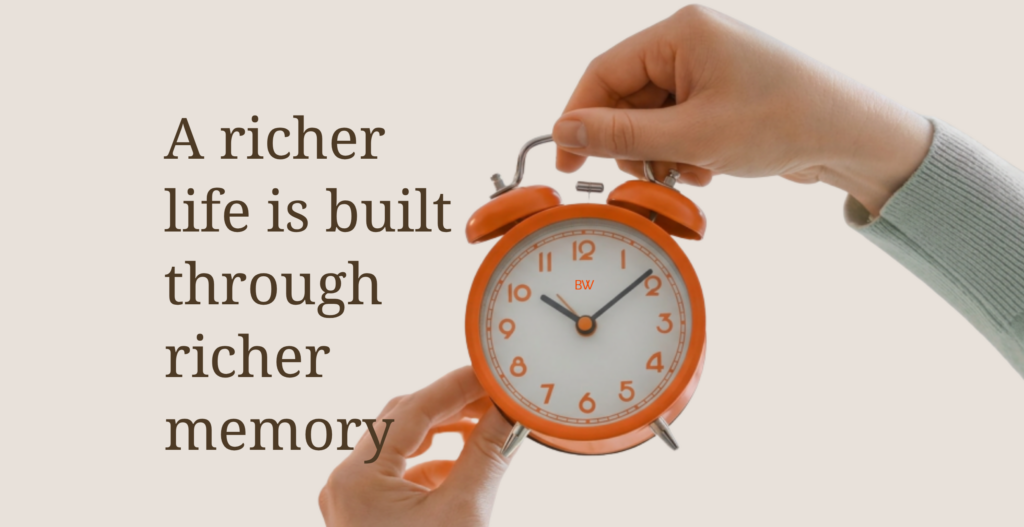
Memory density is the number of meaningful, distinct, and emotionally recognizable moments we create within a period of time.
A year with few new experiences may pass quickly in memory.
A year filled with learning, travel, creation, challenge, deep conversations, and meaningful decisions may feel fuller because it carries more memory markers.
This is why a short trip can feel longer than an ordinary month.
It is why starting a new project can give a season a clear identity.
It is why learning a new skill can make life feel more alive.
It is why building something meaningful can turn time into a chapter.
The goal is not to make life busier.
The goal is to make life more memorable.
How to Make Time Feel Richer Again
To make time feel richer, we do not need to completely redesign our lives overnight.
We need to create more moments the mind cannot ignore.
That can be simple.
Learn something new.
Go somewhere unfamiliar.
Take a different route.
Start a meaningful conversation.
Build something you care about.
Begin a creative project.
Try something that challenges your usual identity.
Make one decision that marks the start of a new chapter.
These moments create contrast.
They wake up attention.
They give the mind something to hold.
And over time, they make life feel fuller.
As a strategic leadership coach, Bonnie Wu often speaks to the importance of clarity, awareness, and intentional daily practice. That applies not only to business growth, but also to the way we experience time.
A meaningful life is not built only through major milestones.
It is built through the moments we choose not to sleepwalk through.
The Role of New Experiences
New experiences are not always comfortable.
Sometimes they feel uncertain.
Sometimes they feel awkward.
Sometimes they make us question whether we are ready.
But unfamiliar does not mean wrong.
New experiences ask us to pay attention. They pull us out of automatic living. They require us to observe, adapt, decide, and participate more fully.
That is part of their value.
If life has started to feel fast, flat, or repetitive, the answer may not be to do more of the same.
The answer may be to bring more presence and novelty into the life you already have.
Not novelty for the sake of distraction.
But meaningful newness.
The kind that helps you grow.
The kind that gives your life texture.
The kind that creates a chapter you will remember.
A Reminder for Midlife and Beyond
For many people, reaching a new decade can feel like a countdown.
Thirty.
Forty.
Fifty.
Each milestone can make us more aware of time.
But these ages do not need to feel like loss. They can become reminders.
A reminder to live more richly.
A reminder to create more deliberately.
A reminder to stop letting years blur together.
A reminder to build a life with chapters worth remembering.
The question is not only:
“How much time do I have?”
The better question may be:
“How fully am I experiencing the time I have?”
This shift matters.
Because a long life is not only measured by duration.
It is also measured by depth.
The Daily Practice of Remembering Your Life
The Daily Practice is not about making every day extraordinary.
It is about living with enough awareness that ordinary days do not disappear unnoticed.
You do not need every day to become a major event.
You only need to create small moments of attention, meaning, growth, and memory.
A walk somewhere new.
A sentence written honestly.
A conversation that matters.
A lesson learned.
A decision made with clarity.
A project started before you felt fully ready.
These are small moments, but they are not meaningless.
They are how life becomes textured again.
They are how time becomes less blurry.
They are how the year begins to feel like a chapter, not just a passing block of time.
Conclusion
Give Today One Moment Worth Remembering
If your days feel like they are disappearing, it may not be because time is moving faster.
It may be because life has become too easy for your mind to compress.
To make time feel richer, create moments your mind cannot ignore.
Learn something new.
Go somewhere unfamiliar.
Start a meaningful conversation.
Build something you care about.
Break one small routine.
You do not need to change your whole life overnight.
You only need to give today one moment worth remembering.
That is The Daily Practice.