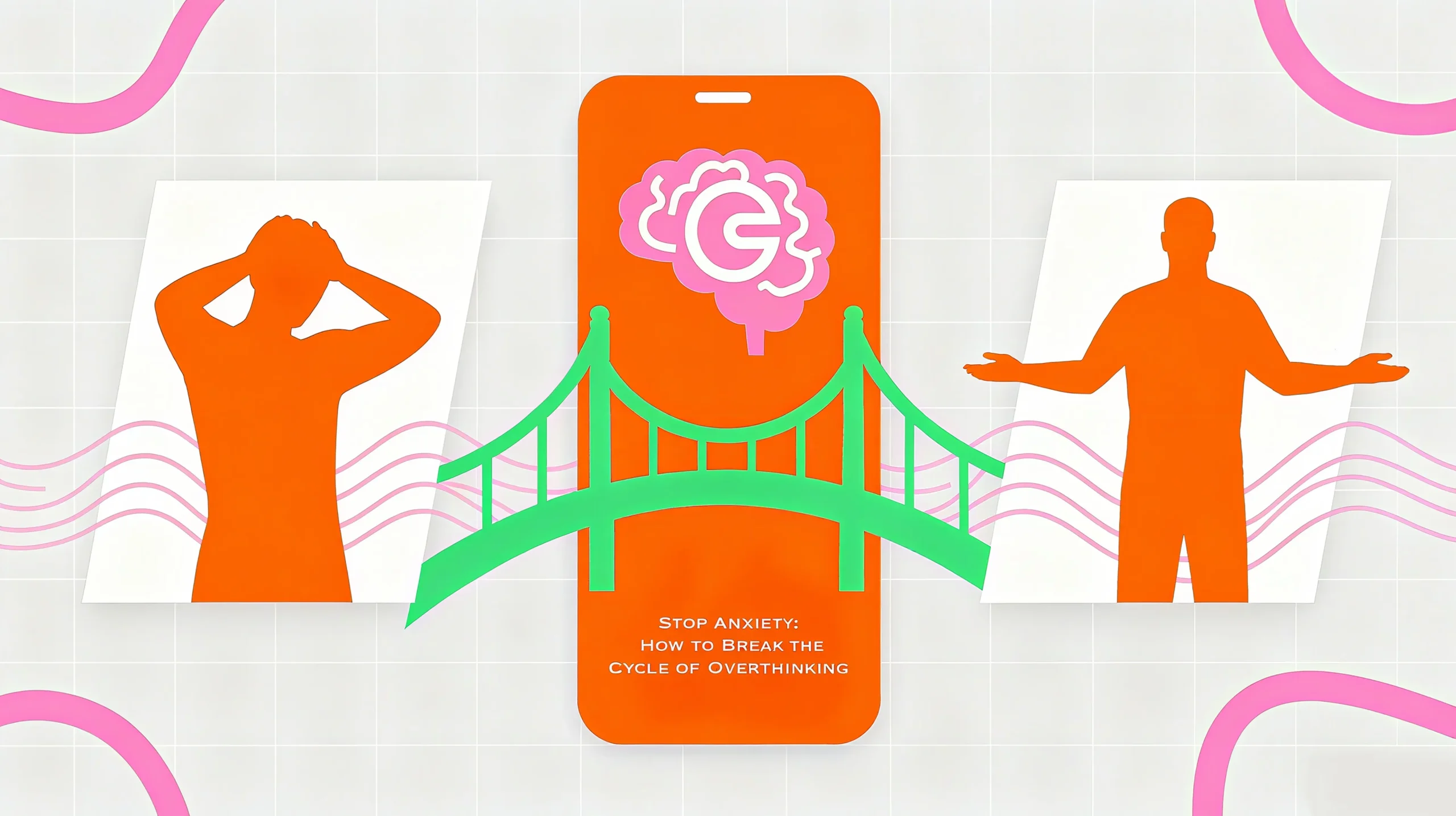
Anxiety is a common mental health issue, affecting countless people worldwide. One of its most common symptoms is overthinking, a relentless cycle of worry, doubt, and “what ifs.”
Being caught up in overthinking can hinder decision-making and prevent you from feeling calm. In this guide, we’ll provide practical strategies to help you stop anxiety, break the cycle of it, and regulate your thoughts and emotions.
1. Are You Stuck in a Cycle of Overthinking?
To determine if you’re stuck in this cycle, consider whether the following symptoms apply to you:
- Constantly worrying about future events that haven’t happened yet and constantly assuming the worst.
- Replaying upsetting or embarrassing past conversations or actions before bed.
- Having trouble making decisions about everything, even the smallest matters.
- Overinterpreting your own or others’ reactions.
- Knowing that excessive worry and anxiety are useless, but unable to stop.
If these symptoms appear frequently in your life, you may be stuck in a vicious cycle.
2. Why Do We Fall into Overthinking?

From a psychological perspective, overthinking is often a manifestation of anxiety. When we feel uncertain about the future and lack a sense of control, our brain attempts to find the “safest solution” by replaying scenarios. However, this strategy is ineffective and fails to solve practical problems. Instead, it only makes us more anxious.
Possible causes of this mindset include:
Perfectionism: Always striving for the best in everything, fearing imperfection and failure.
Low self-esteem: Excessive focus on others’ opinions, constantly worrying about being rejected or misunderstood.
Influenced by upbringing: People who were frequently criticized and denied in childhood and rarely experienced positive emotional value are more likely to overthink.
Innate sensitivity: Highly sensitive to negative information and emotions, ruminating on them until exhaustion.
3. Stop Anxiety: 5 Practical Ways to Stop Overthinking
To break this cycle, you must address both behavioral and cognitive aspects. From recognizing the problem, understanding its causes, and then resolving it, here are five ways to help you achieve your goal of “stop anxiety.”
- 1. Set Aside Some “Thinking Time” Every Day
You can set aside a fixed time each day for “thinking time,” usually about 20 minutes. The specific time can be tailored to your needs. It could be during your lunch break or before bed. Only during this time should you allow yourself to worry, plan, or analyze problems. If you notice yourself thinking outside of this time, stop immediately and remind yourself, “Now is not the time.”
- 2. Practice Meditation
Meditation can restore mood. The core of meditation is focusing on the present moment and objectively observing your thoughts and feelings. Just 15 minutes of daily practice can gradually reduce negative thought patterns.
- 3. Write Down Your Recurring Thoughts.
If you’re constantly thinking about the same thing over and over again, consider writing it down on paper. For example, “What if I fail?” “What if the other person doesn’t like me?” “What if the other person misunderstands me?” By writing down these thoughts, you’ll discover that your recurring concerns are actually highly repetitive. Some of these concerns may even have no factual basis, simply subjective judgment.

Writing them down on paper can help you clearly understand your recent thoughts. You can also create a mind map based on what you’ve written down. List the reasons and process for each thought, and then think about practical solutions. Writing down your thoughts on paper can help you externalize your emotions and relieve internal stress.
- 4. Take Direct Action
Taking direct action to solve problems can give people a sense of control and certainty. Once these two feelings are achieved, anxiety can be greatly alleviated. When people are taking action, they are naturally immersed in their work, reducing the frequency of overthinking. Before taking action, set a goal. It doesn’t have to be perfect; just do your best within your capabilities. Additionally, make decisions quickly. Set a time limit for making decisions and quickly determine your next steps. Avoid excessive deliberation.
- 5. Seek Help from Others
If you find yourself struggling with anxiety, or it’s interfering with your daily life, don’t hesitate to seek help from a professional doctor or counselor. Cognitive behavioral therapy is very effective in treating anxiety. It’s crucial to address psychological issues that interfere with your life as soon as possible; delaying them can only make the situation worse. Besides seeking professional help, sharing your concerns and problems with trusted friends or family is also a good way to alleviate anxiety.
4. Recognizing the Problem is the Beginning of Solving It
To truly stop anxiety, we must begin by recognizing the problem. The moment you realize, “I’m overthinking again,” that’s progress in itself. Anxiety isn’t something to be feared; it reminds us to focus on our lives and make changes. The key is to learn how to manage it, not let it control us. Emotions enrich life. We must learn to be masters of our emotions, not slaves.
5. Conclusion
Anxiety won’t go away, but it can be managed. Breaking the cycle of anxiety and overthinking is a long process. But every time you acknowledge the emotion and every action you take to solve it, it builds momentum for change. Solving this problem isn’t easy. But as long as you’re willing to take action, there are always more solutions than problems or challenges.
Related Reading
1. How A Life Coach Help You Relieve Stress? 4 Steps To Regain Control